

Supreme Court Decision Clarifies Standard for Student Disability Discrimination Claims Against Schools
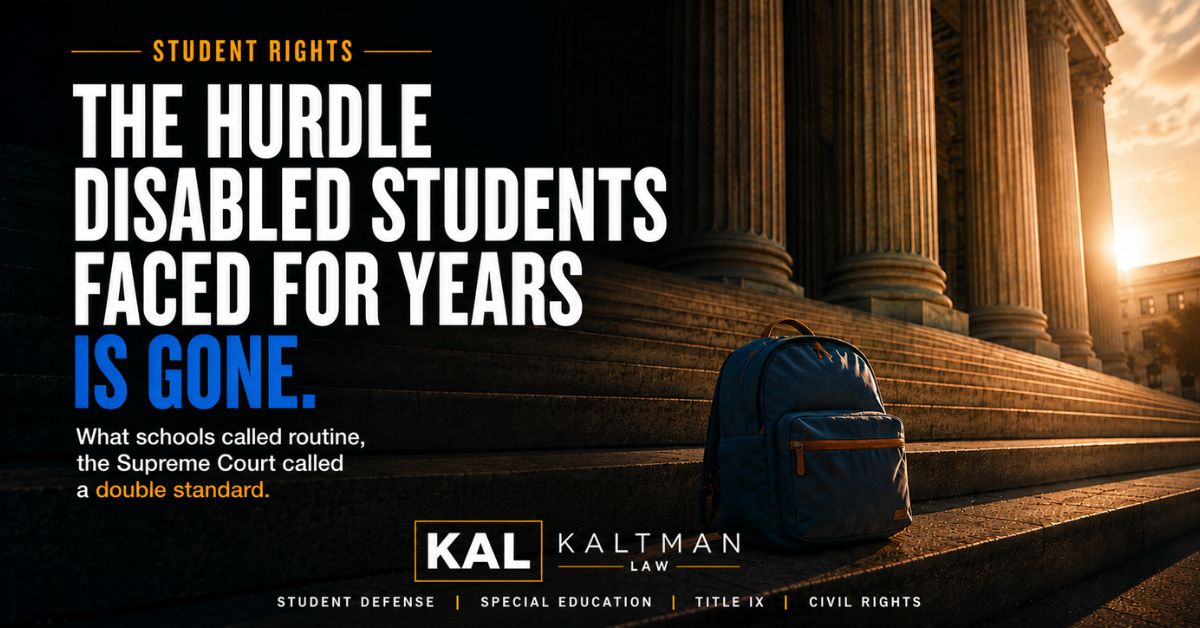
For years, disabled students had to climb higher than everyone else to be heard. The climb just got shorter.

Keith Altman Founder of K Altman Law
Schools can't hold disabled students to a higher bar anymore. The Supreme Court just said so — and families need to know it.
Why the ruling matters:
The Court’s opinion addresses a procedural barrier that had made some education-related disability claims harder to pursue in certain jurisdictions. According to the opinion, nothing in the text of Title II or Section 504 supports imposing a distinct, more demanding standard simply because the claim arises in the educational services setting. The Court vacated the Eighth Circuit’s judgment and remanded the case for further proceedings.
For families, the decision is a reminder that an IDEA dispute and a disability discrimination claim are not always the same thing. Schools still have obligations under the Individuals with Disabilities Education Act, but Section 504 and the ADA provide separate antidiscrimination protections. When educational access, accommodations, or equal participation issues arise, careful issue-framing and record development remain critical.
“Families often assume that if a school frames a problem as merely an IEP disagreement, that ends the analysis. It does not,” said Keith Altman, Founder and Managing Partner of K Altman Law. “When a student is denied meaningful access because of disability, schools and families should evaluate not only IDEA obligations but also the independent protections available under Section 504 and the ADA.”
The decision does not guarantee outcomes in any individual case, and the legal standard for damages issues may still require further analysis depending on the jurisdiction and facts. But it does reinforce that students with disabilities should not face extra hurdles simply because the dispute arises in a school setting.
What families and students should do now:
● Preserve emails, evaluations, IEPs, Section 504 plans, meeting notes, and attendance records.
● Document how the school’s decision affected access to instruction, services, transportation, scheduling, or participation.
● Ask for written explanations when accommodations are denied, reduced, or delayed.
● Evaluate whether the issue is solely an IDEA matter or may also implicate Section 504 or ADA discrimination protections.
● Seek jurisdiction-specific legal guidance before making strategic decisions about complaints, hearings, or litigation.
About K Altman Law:
K Altman Law represents students, families, and professionals in matters involving education law, civil rights, student defense, special education, Title IX, and related administrative and litigation issues nationwide.
Disclaimer
This press release is for general informational purposes only and is not legal advice. Outcomes vary by facts and jurisdiction. Reading this material does not create an attorney-client relationship.
Keith Altman
K Altman Law
+1 888-984-1341
kalonline@kaltmanlaw.com
Visit us on social media:
LinkedIn
Instagram
Facebook
YouTube
TikTok
X
Legal Disclaimer:
EIN Presswire provides this news content "as is" without warranty of any kind. We do not accept any responsibility or liability for the accuracy, content, images, videos, licenses, completeness, legality, or reliability of the information contained in this article. If you have any complaints or copyright issues related to this article, kindly contact the author above.
